A wig you will wear tomorrow, a freshly washed wig and a spare packed away for a while have different storage needs. Start with that job before choosing a stand or a matching row of boxes. A useful arrangement gives the piece enough support and space without turning your dressing area into an obstacle.
The three storage jobs
- Between wears: a suitable support in an accessible, dry place.
- After washing: the drying method specified for that fiber and cap.
- For a longer break: appropriate protective packaging, only once the piece is completely dry.
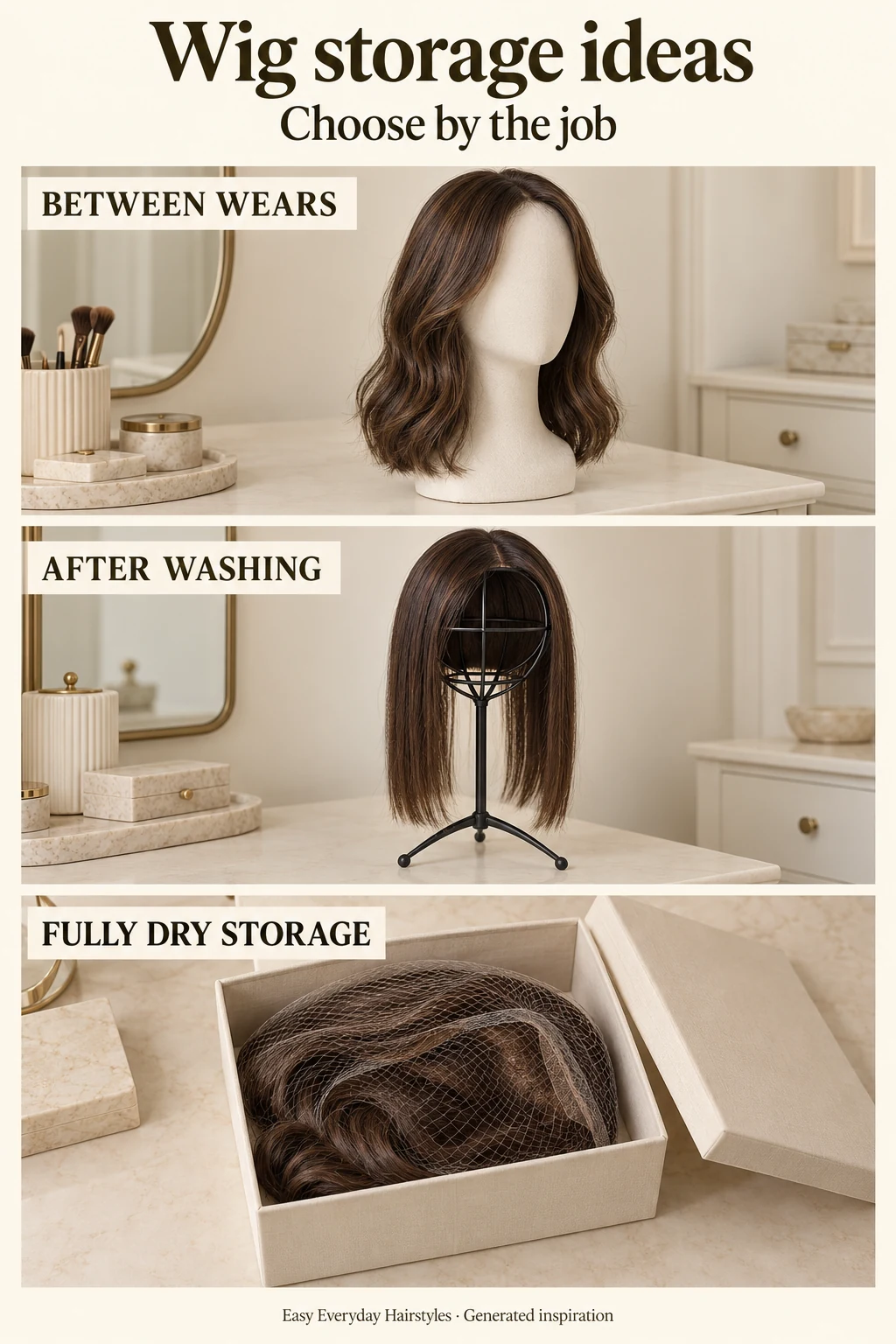
Plan around the wig, not just the stand
Measure the surface you can actually give to storage. Include the base of the support, the space the hair occupies and room to lift the piece without catching it on a shelf above. A stand can fit inside a cupboard while the wig itself brushes against the door, so measure the whole arrangement.
Length matters here. A short bob and a long layered wig can use the same base yet need very different vertical clearance. Plan somewhere for the ends to hang or rest as the maker directs. Do not assume that folding a long style into the space for a short one is harmless.
Think about access before adding a second support. Can you reach the back piece without moving the front one? Could a drawer still open normally? Try the empty layout first. Keeping the most frequently worn piece accessible may be more useful than displaying the whole collection at once.
Between wears: support without crowding
A wig stand or correctly sized head form gives an everyday piece a designated place. They are different shapes: a solid form supports a fuller area, while an open stand leaves more air space. Choose according to the exact wig's construction and its care instructions rather than using appearance alone.
A form that looks tidy in a photograph may be too large for a particular cap. Do not stretch a cap onto a support to make it fit. Keep lace, clips and attachment areas free from catching or unnecessary pressure. If the supplier gives specific support or positioning instructions, use those for that piece.
Give each wig a clear place instead of letting the fibers of neighboring pieces overlap. Keep its care label or product information nearby so the next person using the storage knows which piece they are handling. That is especially useful when similar-looking wigs have different fibers.
After washing: the fiber decides the method
Identify whether the piece is conventional synthetic, heat-friendly synthetic or human hair, then read its own care directions. A natural-looking photograph cannot establish fiber type or heat tolerance. Our natural-hair styling guide is not a substitute for wig instructions.
For its conventional synthetic fiber, Jon Renau's care card specifies natural air drying on a plastic or wire wig stand, no blow drying, and a completely dry cap before placing it on a canvas block head. Those are that manufacturer's fiber-specific directions, not a universal method for every wig or topper.
Set aside the required drying space before washing. A box you intend to close and a crowded shelf are different from the drying arrangement in the instructions. If the maker's directions are missing, ask the supplier rather than borrowing heat settings or drying times from a hairstyle tutorial.
Longer breaks: protection without compression
Keep the original packaging and net if the supplier intends them for storage. Before packing a fully dry piece, check how it should be positioned and whether a styled shape needs additional protection. A curly or specially set style may require different handling from a simple straight piece; do not force both into the same small container.
Choose a box by its usable interior, not its outside dimensions. A decorative lid or thick lining can take away space. Place the intended contents gently in the open box before deciding whether it works. The lid should not have to press the hair down to close.
Label the outside with information that helps you choose: the style, fiber and where its care directions are stored. Keep separate pieces from tangling together. Retailer guides differ on bags and folding methods, so follow the exact supplier's instructions rather than treating one packaging material as universally right.
Travel is a separate packing decision
A foldable stand can be convenient at the destination, but it does not protect a packed wig from pressure inside a bag. Consider the protective case and the destination support as separate jobs. Measure both against your luggage before buying a travel kit.
Leave room for the care items that actually belong to that fiber, with their own labels and closure instructions. Do not add a natural-hair oil, detangler or shampoo just because it appears in a general haircare collection. Keep the supplier's care information available during the trip.
What to check before choosing an accessory
- The support's dimensions, base and intended use.
- Clearance for the full wig and access around it.
- Compatibility with the cap, lace and attachments.
- The maker's cleaning, drying and storage directions.
- Whether a case, stand or net is included or sold separately.
One suitable place for the wig you use most is a sensible starting point. Add storage when there is a distinct need, rather than copying a large collection display into a small room.
Sources and editorial method
Updated 23 October 2026. We checked the Jon Renau Wire Wig Stand, its synthetic-fiber care card, and the separate Simply Wigs and UniWigs storage guides. Retailer examples informed the questions to compare; they do not establish compatibility with every piece. This is original planning guidance with generated imagery, not hands-on testing or a guarantee of longer product life.
For natural-hair styling decisions, explore our separate tools and product-role guide or named haircut references.