Choose the job before adding another bottle. A rinse-out conditioner, a mask and a leave-in can occupy different places in a hair routine. Their names and packaging do not tell you everything: the exact formula's directions decide how to use it.
Compare the three jobs · Check the label · Build a smaller routine
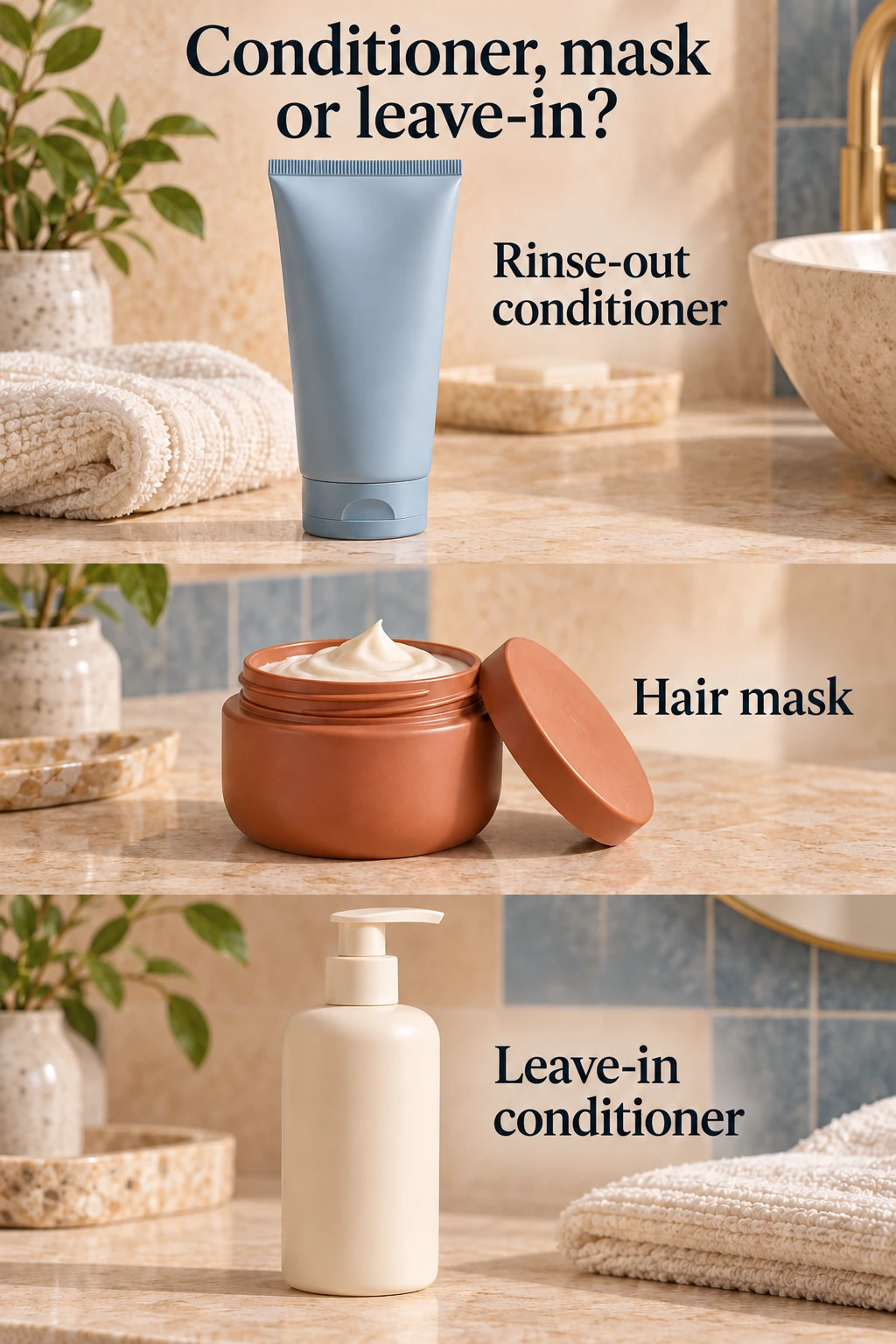
Choose the conditioning job
| Product role | The decision it helps with | What the label must settle |
|---|---|---|
| Rinse-out conditioner | A conditioning step during the wash | Where to apply it, how long to leave it and how to rinse |
| Hair mask or deep conditioner | A treatment step with its own directions | Whether it replaces another step, its timing and whether it must be rinsed out |
| Leave-in conditioner | Conditioning that remains on the hair after application | Suitable hair condition, application amount and any specific styling claims |
These are product roles, not a ranking from weakest to strongest. A mask is not automatically the right purchase because it sounds more intensive. A leave-in is not simply an ordinary conditioner used without rinsing.
Curlsmith's conditioner guide separates rinse-out, deep-conditioning and leave-in use. That distinction is useful when reading a routine, but the selected product still needs its own instructions.
Do you need conditioner and a mask in the same wash?
Start with the mask's directions and your existing routine. Some products are intended to replace a conditioning step on the days you use them. Others specify a different order. Do not add both automatically because a chart shows two bottles.
For example, OLAPLEX's comparison of its two masks describes using a mask in place of conditioner. That is guidance for those products, rather than a universal order for every mask on the shelf.
Identify the problem you are trying to change. Is detangling awkward during washing? Do the lengths feel coated after styling? Are you adding a richer formula without knowing which existing step it replaces? Those questions are more useful than copying someone else's entire shelf.
Keep notes on what you actually change. Trying one new step at a time makes it easier to understand its place in your routine than replacing the cleanser, conditioner, mask and styler together.
Where a leave-in fits
A product designed to remain on the hair has a different use from one designed to be rinsed away. Check the actual leave-in's application instructions, including whether it goes onto wet, damp or dry hair. Do not transfer the amount or application area from another product simply because both use a pump.
OLAPLEX's leave-in explanation specifically distinguishes leave-in from regular conditioner. It is a useful reason to check the wording on a bottle rather than improvising with a rinse-out formula.
A leave-in also does not establish every other styling function. Hold, definition, shine and heat protection need their own product-specific information. If you plan to use a dryer or straightener, check the tool's intended use and the exact product's directions together. “Conditioning” alone does not establish heat protection.
What to check before choosing a formula
- Intended use: rinse-out, leave-in or a clearly explained multi-use formula.
- Application directions: the hair condition, amount, area, timing and removal instructions for that exact product.
- Your existing steps: identify what the new product replaces or adds.
- Formula and label information: compare relevant ingredients and warnings against your own known sensitivities and preferences.
- The real pack: size, dispenser, refill or travel format, and the contents of any bundle.
Hair length, the amount of hair and how it responds to products are separate considerations. Two people with a similar curl pattern can still use different amounts or prefer different textures. A generated picture of glossy hair cannot establish which formula either person needs.
Avoid making the container do the explaining. A jar can hold several kinds of cosmetic product; a tube can contain a rinse-out or a leave-in. Use the product name and directions, not our illustration's shape, to identify the role.
Keep the routine as small as it needs to be
If your current conditioning step is doing its job, there is no need to buy all three formats to complete a routine pictured online. Choose one clear reason for adding a product and check whether it duplicates something you already own.
After conditioning, your next decision may be styling rather than another treatment. Our tools and product-role guide distinguishes drying, shaping, definition and hold. Keep those jobs separate when deciding what belongs in your wash-day kit.
This guide compares product roles and label checks. It does not report a personal product trial or promise a particular repair, curl or color result.